MongoDB

I lead the engineering team behind Atlas API Experience Platform (APIx Platform) at MongoDB. APIx Platform is the platform team that owns the Atlas Admin API itself, the standards and tooling around it, and the operational disciplines that keep it healthy. The platform enables all downstream integrations (IaC, CLIs, SDKs, Postman collections, and other tooling).
What APIx Platform owns
I authored the team’s charter and continue to evolve it as the platform’s surface area grows. The team owns eight distinct areas:
- API platform lifecycle: versioning, stability levels, the release train, /v1 EOL and sunsetting, and the versioned Atlas Admin API itself.
- API design standards: the IPAs and the API Champions program that propagates them across product teams.
- Breaking-change policy and detection, OAS validation, and the guardrails / reviews / IPA exceptions that go with them.
- Domain modeling for programmatic interfaces: use-case solidification, example generation, end-to-end test extensions, and focused engagement with teams to improve their domain expertise.
- Producer enablement and platform plumbing: CI/CD support, the API Registry, and native control-plane support for the Admin API.
- Traffic management: Admin API rate limiting.
- Observability and API health: API Telemetry, the API Health Platform, global metrics / logging / tracing, usage analytics, SLO tracking enablement, and proactive degradation detection.
- One API: establishing and preserving the Admin API as the source of truth for all Atlas operations, and consolidating MongoDB Atlas’s programmatic interfaces so every customer-facing behavior is exposed consistently to Infrastructure-as-Code tools, by default and by design.
Building the team
The role has been fully remote from day one. I joined as the team’s first lead, stepping into a new company, a new tech stack, and my first engineering-management role at the same time, and grew it to its current size of nine engineers across EMEA. I sourced several hires directly, outside the company’s standard recruiting pipeline, during a period of constrained hiring capacity. Beyond hiring for my own team, I have referred Product Managers and Staff Engineers to other teams, and participated in the hiring pipelines of many of them. Multiple engineers on the team and adjacent teams have been promoted while reporting to me, including engineers I mentored cross-team. Every year since I joined I have hosted a summer intern on the team, scoped a well-defined and ideally public-facing project on the API surface, and coached the engineer who mentors them day to day. Several have since joined the team full time.
As the platform’s surface area has grown, I authored the proposal to expand APIx Platform with a second team focused on platform health and reliability, leaving the existing team to deepen its focus on standards and developer experience.
The team operates on the Leader-Leader model from David Marquet’s Turn the Ship Around. Engineers own initiatives end-to-end and bring decisions to me framed as “I intend to…” rather than “what should I do?” My job is to clear the path, not to gate the work.
The approach shows up in two institutional signals. The team has scored consistently high in calibration cycles across the org. I have consistently placed in the top tier of MongoDB’s company-wide manager engagement surveys across multiple cycles, with people development the recurring theme in 360 feedback. I also represent the API Platform in MongoDB’s quarterly business reviews.
Beyond my own team, I’m a frequent consultative partner for other Lead Engineers across MongoDB Engineering when their work touches auth or API design.
Selected delivery
- Service Accounts and platform authentication. Led MongoDB Atlas’s programmatic-auth modernization end-to-end. Service Accounts brought the OAuth client-credentials flow to Atlas as the primary modern auth surface, and the related API Gateway authentication work covered the Digest path the platform retains for legacy clients. The team’s approach to the Launch Readiness Review for Service Accounts became the company-wide blueprint for how to drive LRAs on security-sensitive systems. Given the nature of the work, we proactively requested an external penetration test ahead of launch, which the work passed with zero findings. The thoroughness of the launch approach earned recognition from MongoDB’s CTO, who had nothing to push back against.
- JWT Claim Standards. A self-driven initiative to make MongoDB Cloud’s authentication systems better and drive shared understanding across teams. The proposal was widely adopted by the IAM teams and led to the establishment of PUID (Principal Unique Identifier): a string that uniquely identifies a specific principal within a MongoDB Cloud environment. PUID is now the canonical identifier MongoDB standardizes on for principals across services and JWTs. That level of clarity did not exist before this work.
-
API Rate Limiting. Led the initiative end-to-end, delivered over more than a year. The work brought consistency to how rate limiting works across the Atlas Administration API and shipped a self-service mechanism that lets each Atlas engineering team adapt the policy to its own use cases instead of negotiating one-off rules with my team. Reaching the underlying standards required syncing across dozens of teams. The implementation has since become the team’s reference template for how to drive complex multi-quarter delivery with engineers owning the execution end-to-end.
-
Atlas Go SDK. Drove the technical direction of the SDK and the automated code generation pipeline that underpins it (covered in MongoDB’s engineering blog). Drove the integration of the Atlas CLI with the autogenerated Go SDK.
-
Public Postman collection for the Atlas Administration API. The team built and runs the autogeneration pipeline that produces and maintains MongoDB’s public Postman collection for the Atlas Administration API, keeping it in lock-step with the API spec rather than drifting through manual updates.
-
Cloud Live Migrations. Took over the first implementation of Live Migrations and made the changes that made it operationally trustworthy. Resolved a class of issues around X.509 certificate handling. Extended the automation agent with a validation framework that runs a dry-run before the migration starts, so customers see configuration and network problems before the migration commits rather than midway through. Rewrote the error responses (which were almost all variants of “please try again”) for clarity. Worked closely with a major enterprise design partner to iterate on customer feedback rapidly. The work seeded a dedicated Cloud Migrations team that grew out of this codebase (since renamed to Cluster-to-Cluster).
-
Ops Manager at scale (Enterprise Advanced performance testing). Before this work, performance testing of Ops Manager relied on manually built reference environments with manual setup and teardown. I built fully automated Terraform-and-Ansible-based infrastructure on GCP that stands up over 300 VMs on demand with Automation Agents, provisions MongoDB clusters, seeds them with data, and stress-tests their operation (JMeter, Gatling) in a reproducible way. The work identified two principal bottlenecks at scale, and led to the creation of a dedicated Enterprise Advanced team.
-
Atlas Partner Integrations architecture. Contributed the design that underpins hyperscaler integrations across MongoDB Atlas.
- Release toil reduction. Took a hands-on pass at the team’s pre-rollout release checks, automating a majority of the substantive steps that previously ran as a manual checklist. The change removed a recurring tax on engineering time and made it harder to skip steps under pressure, reflecting a wider DevOps stance of treating repeatable toil as a defect rather than something to live with.
Current focus
My work has shifted from individual features to shaping the platform itself.
- Making Atlas APIs agent-ready. Authored the foundational research and report on the current state of Atlas consumability by LLM-based agents and assistants. The work put the problem into perspective and shaped the roadmap that the broader workstream is now executing on.
- IPAs (MongoDB’s API design principles). I co-authored the Engineering Proposal that became the IPAs and drove the work to publish them externally. The set has grown to 30 published proposals spanning API governance, design patterns, and SDK integration, and is now the design language every API team at MongoDB works against.
- API Champions. I authored the Engineering Proposal for the program and drove it through three phases (pilot, self-serve reviews, multi-team adoption). It embeds a design partner in each product team to propagate the IPAs into every API MongoDB ships. A public blog post on the program is in the pipeline.
- One API. A strategic consolidation of the programmatic surfaces across the Atlas Control plane. It grew out of an unprompted Backend-for-Frontend (BFF) proposal I wrote to back all UI API calls with the Admin API, which became the foundation for the program presented to senior leadership. I authored the decision document for the Phase 1 routing architecture. Routing here is genuinely complex, and getting this extra piece to work required a number of teams to build a shared understanding of where we are, where we want to go, and why, so I facilitated and drove those discussions, grounding them in a data-driven traffic analysis across the few billion daily Admin API calls. I continue to shape the direction and cross-team alignment behind it.
- CNCP (Cloud Native Control Plane for Atlas). I focus on the parts that touch external programmatic consumption: API gateway and other cross-cutting platform features.
- API Telemetry. Capturing the business intelligence behind how the platform is actually consumed, so platform decisions can be made from data rather than from anecdote. PII handling is strict by design, so the telemetry surface stays useful without leaking customer data into operational analytics.
- Atlas Admin API Upgrade Experience. Driving the release trains that orchestrate the Admin API alongside its downstream tooling (SDKs, Postman, CLI) on a predictable cadence. The headline goal is minimizing breaking changes for customers and making upgrades a non-event rather than a quarterly emergency.
Output that left the building
- Author, the Atlas Go SDK engineering blog post on MongoDB’s developer hub
- Featured, Serving as the Digital Bridge: Meet the APIx Team at MongoDB on MongoDB’s company blog (2023)
- Speaker, MongoDB Opening Doors to Discovery (2025)
- Speaker, TU Dublin C++ Society (2026) and Google DevFest TU Dublin (2024) on student-to-engineer transitions
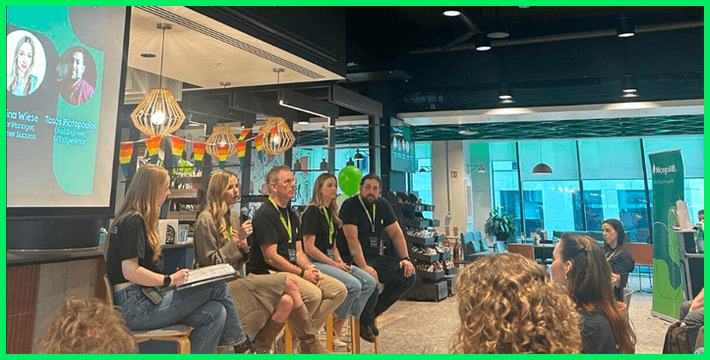
- Volunteer, An Evening with MongoDB Leaders (November 2025), representing the company and the team to attendees
- Continued running DrinkBird alongside the role since I joined
Technologies and practices
Go · TypeScript · Java · OAuth 2.0 · OpenID Connect · JWT · REST · GraphQL · Kubernetes · Terraform · Ansible · Site Reliability Engineering · Distributed Systems · API Design · Leader-Leader management